


William Smith adds Zünd cutter to support growing demand for signage
Jun 26
3 min read
Print Solutions
William Smith Group 1832 has invested in a Zünd S3 digital cutting machine, its fourth Zünd cutter in total and its second S3 model. The addition follows a period of business growth and keeps production capacity aligned with rising demand across its signage operation, including traffic signs, chevron kits and other road safety products where precision is non negotiable.
The decision to specify another S3 was grounded in direct experience. The company first brought an S3 onto the production floor in December 2024, and the capacity gains were immediate. When the time came to expand again, a second S3 was the natural conclusion.
‘The improvements in capacity we saw went through the roof. When it came to upgrading from our existing KN models, the process pointed us straight to another S3,’ said Rob Siswick, production and warehouse manager at William Smith Group 1832.
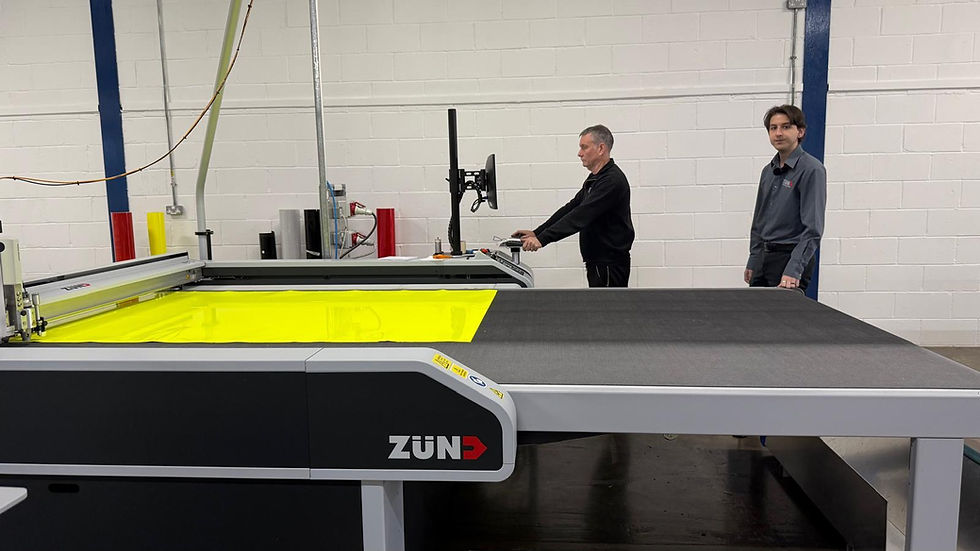
The Zünd S3 is a compact flatbed cutter built around a fast drive system, intelligent control software and a modular tooling set up that can be reconfigured as production requirements change. Two S3 models now run alongside two other Zünd cutters on the production floor, with the team already focused on what that combination means for output.
‘Having two S3s is going to have a direct impact on our customers. We will be passing on those efficiencies and accuracies, and that is what it is all about,’ added Rob.
The S3's compact footprint is part of its appeal. It allows customers to make better use of their floor space without sacrificing the speeds and accelerations associated with Zünd's third generation systems. The vacuum hold down system keeps materials flat throughout the cut, while automated tool initialisation ensures each job starts at the correct cutting depth from the first pass. That level of precision matters particularly when working with reflective films, composites and specialist materials common in road and highway signage, where consistency and clean edges are required on every run.
Modular tooling means William Smith can switch between substrate types without lengthy reconfiguration, which is valuable in a production environment handling a wide mix of signage applications. The latest investment also expands capacity at the company's new production facility, and the sample quality coming off the machine has already drawn attention internally. Jobs move through the entire workflow and arrive as customer ready output, a practical measure of the machine's performance that is difficult to argue with.

The relationship between the two companies stretches back 20 years, and Rob is clear about what has sustained it. ‘Customer service and after sales support have been absolutely amazing, right through from the engineers to the training team. We can't fault them at all,’ he said.
The investment brings William Smith's fleet to four Zünd machines, a straightforward reflection of the scale and pace of the cutting operation the business now runs.
‘Our Zünd machines do a lot of heavy lifting for us. As the business has grown, the demand on the cutting side has grown with it, and this fourth machine means we can take on more work without any drop in the quality our customers expect,’ said Lindsay Hutchinson, head of marketing at William Smith Group 1832.
Lindsay concluded, ‘Four Zünd machines on the floor tells you something about how far this business has come. We invested in the first one because we needed better cutting quality. We have invested in three more because that quality has paid for itself, and we expect this latest one to do exactly the same.’


